If you're a therapist, psychotherapist, or psychologist in Toronto, you're not short on competition. This city has one of the densest concentrations of private practices in the country, which means your website isn't just a nice-to-have, it's often the only thing standing between a prospective client choosing you or choosing the practice one search result above yours.
Here's what that actually means for how a Toronto therapist's website should be built.
Toronto's Market Is Different From a Smaller City's
In a smaller market, the competition looks very different. Barrie, a similarly professional but far smaller Ontario city, shows roughly 742 therapist listings on Psychology Today, about a tenth of Toronto's total. In Toronto, the competition is on a different scale entirely. Open Psychology Today's Toronto directory right now and you'll find 394 pages of results, roughly 7,862 therapist listings, all competing for the same searches you are. That's before counting every other directory, every large multi-practitioner clinic, and every competitor with a bigger marketing budget than most solo practices will ever have.
That changes the calculus. A generic, DIY site might be enough to get found in a smaller market. In Toronto, it usually isn't, not because the work behind it is any less real, but because the competition for visibility is simply denser.
Location-Specific SEO Matters More Here, Not Less
A website that only says "serving the Toronto area" is competing against every other practice making the same vague claim. What actually helps is anchoring your site around the specific neighbourhoods, transit lines, or sub-regions your ideal clients search for, the Beaches, Leslieville, North York, or the specific GTA municipality you actually serve.
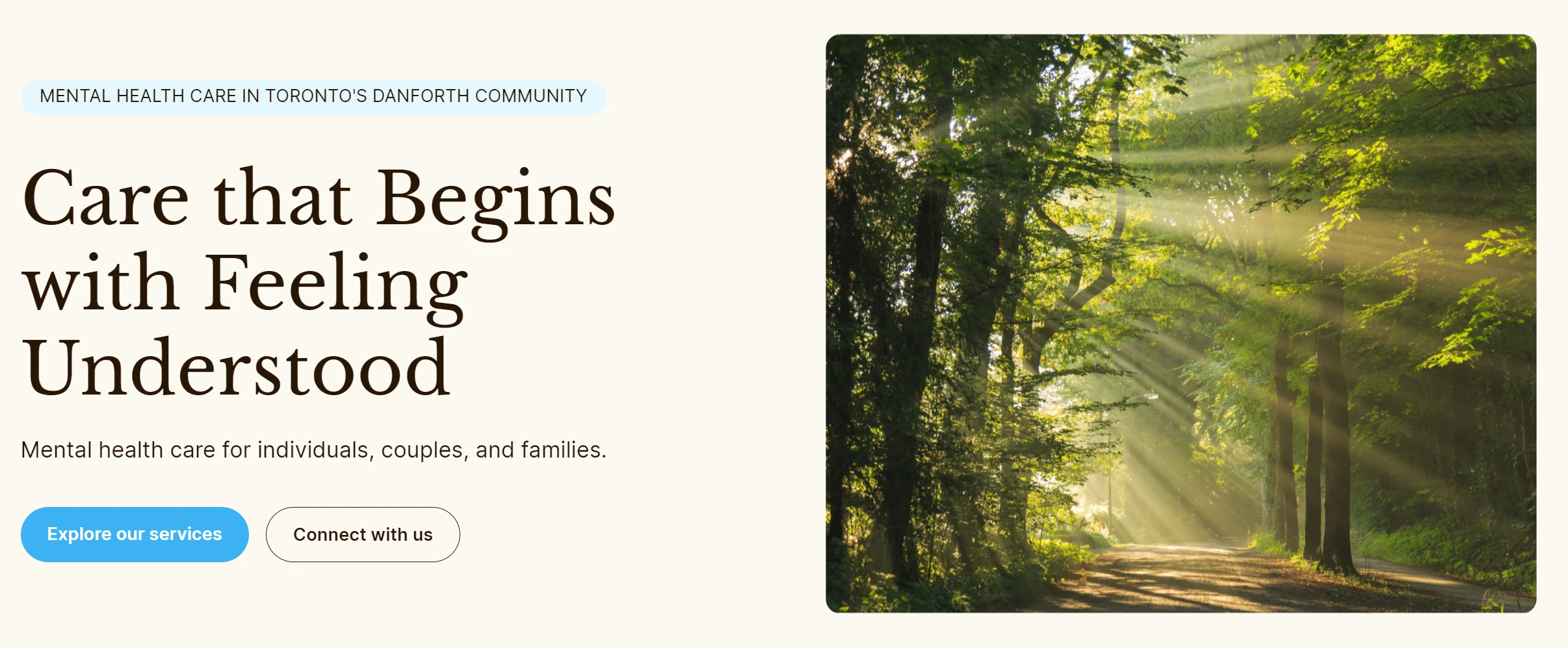
We've done exactly this ourselves. KaZa Family Centre's homepage doesn't say "serving Toronto," it leads with "Mental Health Care in Toronto's Danforth Community," a specific, named neighbourhood a prospective client would actually search for, not a generic city-wide claim competing with thousands of others. See the full KaZa case study →
That specificity is what search engines, and increasingly AI search tools, actually reward.
Toronto Has a Real, Active Therapist Community, and That's Worth Reflecting
This city has an unusually active professional community for therapists and wellness practitioners, associations, in-person meetups, peer supervision groups. It's also where the profession is actually regulated from: the College of Registered Psychotherapists of Ontario (CRPO) is headquartered on University Avenue, and the College of Psychologists and Behaviour Analysts of Ontario sits on Eglinton Avenue West, both right here in Toronto.
Toronto is also one of the most linguistically and culturally diverse cities in the country, and a growing number of clients are specifically searching for a practitioner who shares their language or lived experience. If that's part of your own practice, it's worth reflecting directly on your site rather than leaving it implied.
A website that feels disconnected from any of this, generic stock photography, no sense of the practitioner's actual community involvement or specific identity, misses a real trust signal that a more considered, personal site can capture instead.
Your College's Advertising Rules Apply to Your Website Too
Being headquartered here also means there's no real excuse for a Toronto practitioner's website to accidentally break their own college's rules. CRPO holds registrants responsible for what a third party, including a website developer, publishes on their behalf, so reviewing your own site's claims for testimonial language and outcome guarantees isn't optional, it's worth doing before anything goes live, not after.
A Real Local Example
For a look at how a solo practitioner grew into a full team by anchoring her SEO around the specific areas she wanted to reach, see our case studies →, including practices from across the GTA and beyond.
What a Toronto-Specific Website Actually Needs
- Clear, specific location signals, not just "Toronto," but the actual neighbourhoods and municipalities you serve.
- A clearly labeled address and embedded map, if you have a physical office, along with FAQ content answering the practical questions clients actually have before their first visit, is there parking, is the building wheelchair accessible, how close is the nearest TTC stop.
- A structure built for how AI search tools now answer local queries, not just traditional Google rankings.
- Clearly presented virtual and hybrid session options, since Torontonians spend more time stuck in traffic than any other city in North America, making that flexibility a genuine deciding factor for a lot of prospective clients, not just a nice-to-have line item.
What This Means for Your Practice
Toronto's competitive density is exactly why a strategic, well-built website matters more here, not less. A generic site can survive in a quiet market. In this one, it usually just disappears into the noise.
If you're a Toronto-area therapist thinking about what your website is actually doing for you right now, that's a conversation worth having.