Most therapists I talk to have done everything they were told to do.
They built the website. They wrote the about page carefully and honestly. They listed their services, added their photo, and made sure the contact form worked. They may have even paid someone to help.
And then they waited.
The inquiries didn't come. Or they came slowly and inconsistently, in a way that felt more like luck than a system. And when they Googled themselves, they found their own website somewhere on page two. Maybe page three.
If this sounds familiar, I want to be honest with you about something. The problem almost certainly isn't your website. It's everything happening around your website that you probably haven't been told about.
Google Is Watching More Than Your Website
There's a version of search engine optimization that most web designers sell therapists. The one that's all about keywords on your pages, headings structured the right way, and a fast loading site. And those things matter. But they're the foundation, not the structure.
What Google is actually evaluating when it decides who to show is something closer to trustworthiness over time. It's asking questions like: Is this practice actively operating? Is it showing up consistently across the internet? Are real people engaging with it? Does it have a presence beyond just a website?
A therapy website that launched a year ago and hasn't been updated since signals to Google that your practice might not be active. Not because Google knows anything about you personally, but because silence, in Google's language, reads as irrelevance.
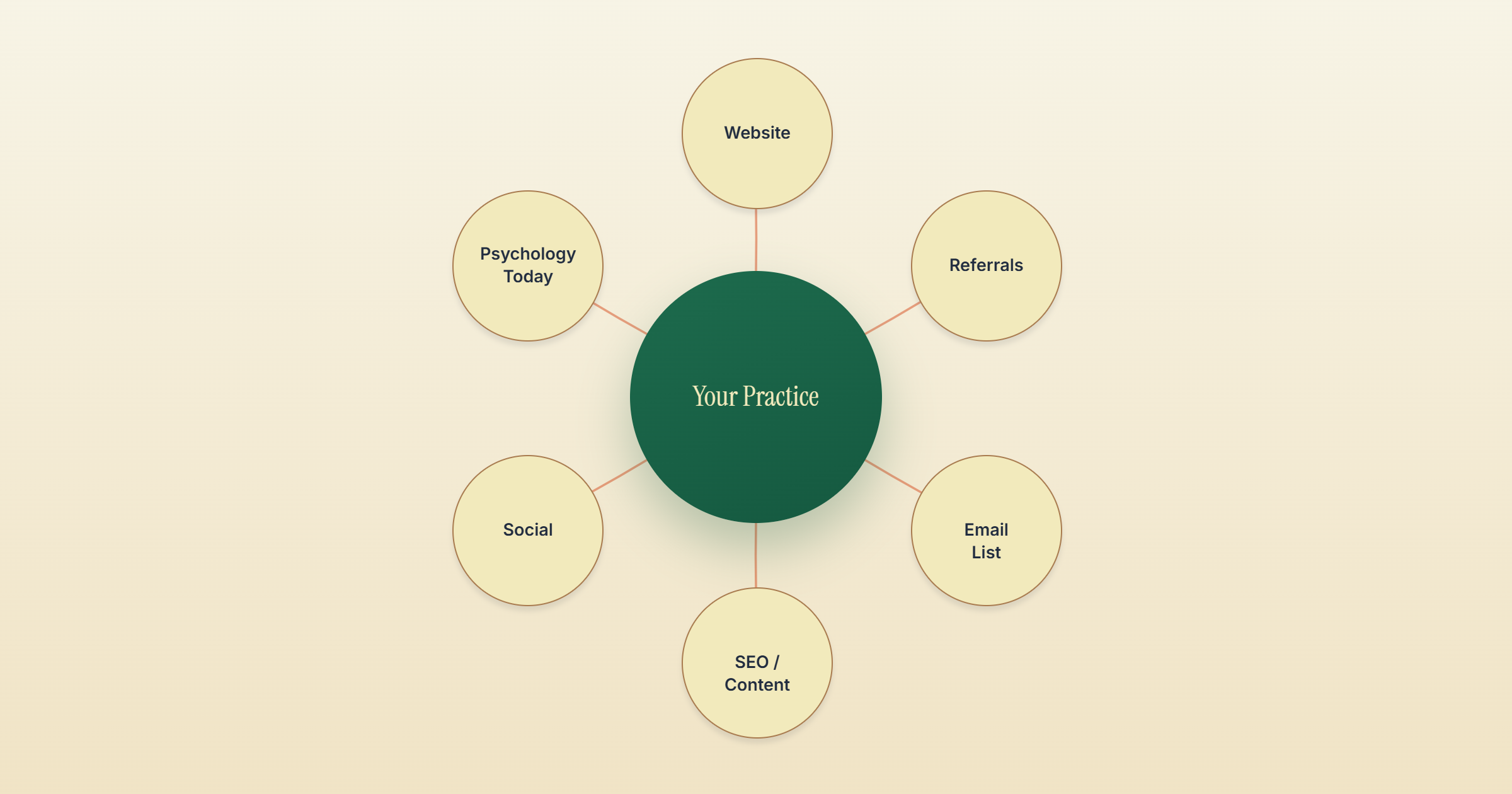
The therapists getting found consistently are not always the ones with the best websites. They're the ones with the most consistent, active, and coherent presence across multiple signals. Here is what those signals actually look like.
Your Google Business Profile Is the Most Underused Tool in Private Practice
When someone in your city types "therapist near me" or "anxiety counselor in [your city]" into Google, something important happens before they ever see a list of websites. They see a map. Three local listings appear front and center with photos, reviews, hours, and a direct link to call or get directions.
That section, called the Local Pack, captures the majority of clicks on any local search. And it has nothing to do with your website's SEO. It's driven entirely by your Google Business Profile.
Most therapists I encounter have one of three situations with their Google Business Profile. They never set it up. They set it up once and never touched it again. Or they set it up and aren't sure if it's actually doing anything.
All three situations tend to produce the same result. They're not showing up on that map.
Google Business Profile rewards activity. Weekly posts, updated services, responses to reviews, accurate and complete information. A profile that's being actively managed signals to Google that your practice is open, engaged, and worth showing to people searching nearby.
The therapist a few blocks from you with half your credentials but a consistently updated Google Business Profile will likely show up before you do. That's not unfair. It's just how the system works. And it's entirely fixable.
Blogging Is Not Dead. It's Actually More Important Than Ever.
I know. The internet is full of advice telling therapists to start a blog, and most therapists I speak with have either tried it and stopped or avoided it entirely because it felt like one more obligation on an already full plate.
But I want to reframe what blogging actually does for your practice, because it's not what most people think.
It's not about posting content for its own sake. It's not about becoming a thought leader or building an audience. For a therapist in private practice, a blog does one specific and very practical thing.
It gives Google more surface area to connect you with the people already searching for you.
Every blog post is essentially a new door into your website. A post about navigating anxiety in a new city. A post about what to expect in your first therapy session. A post about the difference between grief counseling and trauma therapy. Each of those posts can rank for searches that your home page and services page never will.
The therapist who has written honestly and specifically about the things their ideal clients are searching for is the therapist who gets found by those clients. The therapist with five static pages and no new content since their site launched is largely invisible to those same searches.
You don't need to post weekly. You don't need to become a content creator. Two or three thoughtful, specific posts per quarter, written in your actual voice about things you genuinely know, will do more for your long term visibility than most other things you could spend time on.
The New Frontier Nobody Is Talking to Therapists About Yet
Something significant has shifted in the last two years and most therapist marketing advice hasn't caught up to it yet.
People are no longer only using Google to find answers. They're asking ChatGPT, Claude, Perplexity, and Google's own AI summaries questions like "how do I find a therapist who specializes in EMDR in Vancouver" or "what should I look for in a trauma counselor."
These AI tools don't return a list of ten links the way traditional Google does. They synthesize information from across the internet and give a direct answer, often without the person ever clicking through to a website at all.
This emerging practice is sometimes called Answer Engine Optimization, and it's about making sure your content is legible and usable by AI systems, not just Google's traditional algorithm.
What does that mean practically for a therapist?
AI tools prioritize content that is clear, specific, and directly answers real questions. A website with vague service descriptions and no blog content gives AI systems nothing useful to work with. A website with specific, well-written content that addresses the real questions people ask about therapy, what to expect, how to know if you need help, how a particular modality works, gives AI exactly what it needs to reference you as a relevant answer.
The therapists who will show up in AI search results over the next few years are the ones building a body of specific, honest, helpful content now.
The Consistency Problem That Quietly Hurts Your Rankings
Here is something most therapists don't know and most web designers don't mention.
Google cross-references your practice information across every place it appears on the internet. Your website, your Google Business Profile, any directories you're listed in, your Psychology Today profile, your LinkedIn. If your name, address, or phone number appears even slightly differently across those platforms, a suite number on one and not another, a different phone number format, a slightly different business name, Google can treat those as signals of an inconsistent or unreliable business.
It's called NAP consistency, which stands for name, address, and phone number, and it has a real impact on local search rankings that is almost entirely invisible to therapists managing their own presence.
This is not a dramatic fix. It's tedious rather than difficult. But going through every place your practice appears online and making sure the information matches exactly is the kind of unglamorous work that quietly improves where you show up over time.
Putting It Together
None of these things in isolation will transform your visibility overnight. But together, an active and complete Google Business Profile, consistent blogging, content that's legible to AI search tools, and consistent information across platforms, they create a compound effect that builds over time.
The therapists who are consistently getting found online are not the ones who did one big thing. They're the ones who have been consistently doing several smaller things for long enough that Google and AI systems have learned to trust them.
The honest reality is that most of your local competition isn't doing this. The bar to stand out is not as high as it feels from the outside. It mostly requires consistency, which is admittedly the hardest thing to maintain when you're carrying a full caseload and trying to keep your own life in order.
If you're ready to take your online visibility seriously and want a team that understands the therapy world, we'd love to help. Book a free 30-minute call here and we'll look at your current situation honestly and talk about what would actually make a difference for your practice.