KaZa Family Centre

The Overview
We partnered closely with the KaZa team to clarify their positioning within the therapy and assessment space — identifying what made their approach distinct and how that should translate online.
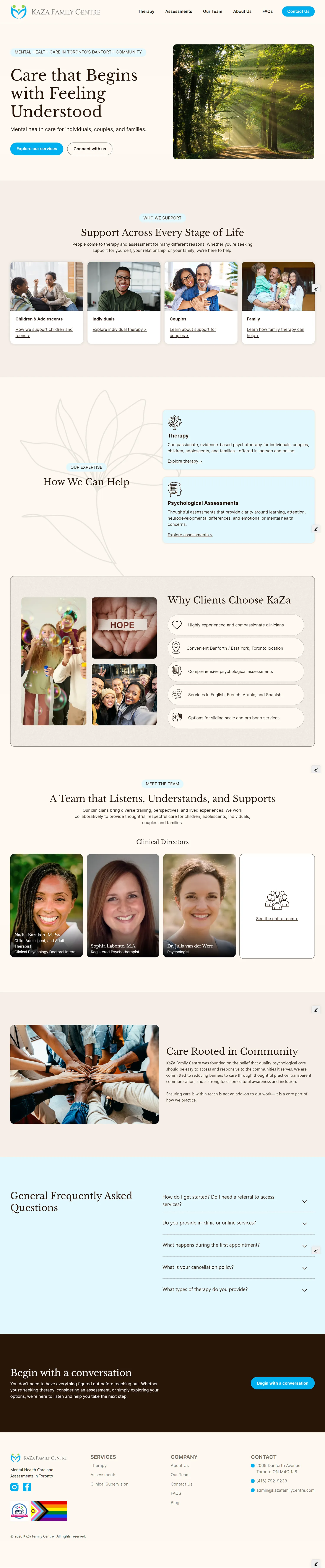
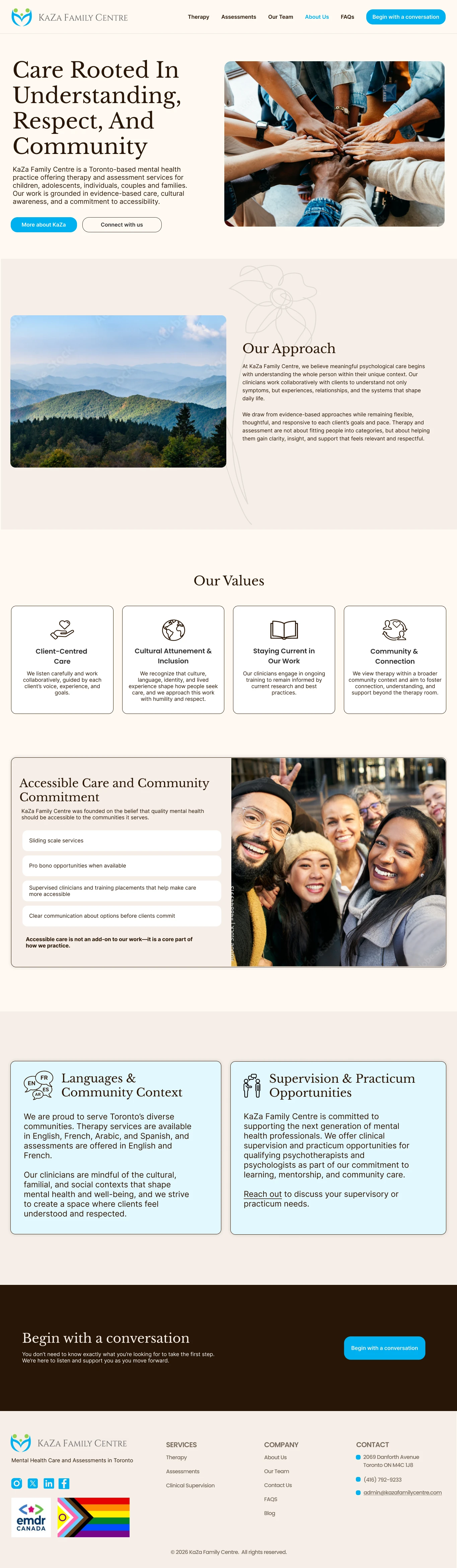
From there, we developed updated messaging, structure, and visuals that aligned with their values of inclusivity, accessibility, and clinical excellence — ensuring the website reflected both warmth and authority.
The Challenge
KaZa Family Centre had an existing website, but it no longer reflected their evolving brand or positioning as a therapy and assessment practice.
As their services expanded and their message of culturally attuned, inclusive care became clearer, the site felt misaligned — both visually and structurally.
They needed a digital presence that matched their professionalism, supported their growing team, and made it easier for clients to understand and access their services.
The Result
Shortly after launch, KaZa began receiving new client inquiries from people who found them online — something their previous site wasn't generating.
"We have had a positive response to the new website. There has definitely been an uptake in intakes. It has given us more confidence to continue to strategize our marketing plan and to begin hiring at least one new clinician. Thank you for making it such a positive experience."
— Nadia Barakeh, KaZa Family Centre
Website Design
Services Delivered
We restructured the site architecture to make key information easy to find — especially around therapy services, assessments, and clinician profiles.
Navigation was simplified to reduce cognitive load, and subtle GSAP animations were introduced to create smooth transitions and a calming, guided experience throughout the site.
The site was built in Webflow with a flexible CMS structure that empowers the KaZa team to manage clinicians, services, FAQs, and blog content independently.
We also implemented a dynamic clinician filtering system, allowing users to quickly find the therapist best suited to their needs — improving usability and supporting informed decision-making.
We refined KaZa’s meta titles and descriptions to improve organic visibility and local discovery.
Structured schema was implemented to support enhanced search results and AI-powered referencing.
Tracking and insight tools — including Google Tag Manager, Microsoft Clarity, and Google Search Console — were integrated to monitor performance, user behavior, and ongoing optimization opportunities.