If your entire client pipeline depends on your Psychology Today profile, you don't have a marketing plan. You have a directory listing, and you're hoping it's enough.
For a lot of therapists, it has been enough, at least for a while. You built a profile, wrote a bio, picked your specialties, and the inquiries started coming in. It felt like marketing was handled. Check the box, move on to the work that actually matters: seeing clients.
But a directory listing and a marketing strategy are not the same thing, and the gap between them is starting to show.
What Psychology Today Actually Is
Psychology Today is a directory. A good one, with real reach, and for many practices it's a legitimate source of referrals. But a directory does one job: it puts your name in a list next to dozens of other names, all competing for the same search.
That's the whole model. Someone searches "therapist for anxiety near me," and your profile appears alongside 40 others who checked the same specialty boxes, in the same city, at similar rates. The person scanning that list isn't getting to know you. They're comparison shopping, often on price, insurance, and how many "trauma-informed" or "somatic" keywords line up with whatever they Googled the night before.
You didn't build that system. You rent a small corner of it.
The Problem With Renting Your Whole Pipeline
Here's the part that matters for your practice long term: you don't own anything on Psychology Today.
You don't own the platform. You don't own the algorithm that decides how visible your profile is this month versus last month. You don't own an email list of people who found you there. If PT changes its pricing, adjusts its search ranking, or simply has an off month for your niche, your inquiry volume moves and there's nothing you can do about it except wait it out.
Compare that to a website you own. Every visitor is yours to follow up with, retarget, or nurture through an email sequence. Every piece of content you write builds equity that compounds over time in Google search, not just inside one platform's walled garden. A referral partner can send someone directly to a page built specifically to convert that kind of client, not a generic profile competing for attention against your own colleagues down the street.
That's the real difference between a marketing plan and a directory listing. A marketing plan is something you build and control. A directory listing is something you're a tenant in.
Why This Matters More for Therapists Specifically
Most industries don't have this problem quite the same way. A plumber doesn't lose much by being one of forty names on Yelp. But therapy is a relationship-based service, and the decision to reach out to a specific therapist is rarely just about credentials or specialty match. It's about whether the person reading your bio feels like you might actually get them.
Psychology Today gives you 2,000 characters and a headshot to make that case, sandwiched between an insurance filter and a fee range. It's simply not built to carry the weight of "here's why I'm the right fit for you," especially for a niche practice with a specific approach, population, or philosophy.
Your website can carry that weight. It can walk someone through your process, show them what a first session looks like, answer the questions they're too nervous to ask, and let your actual voice come through in a way a directory bio never will.
So What Does an Actual Marketing Plan Look Like?
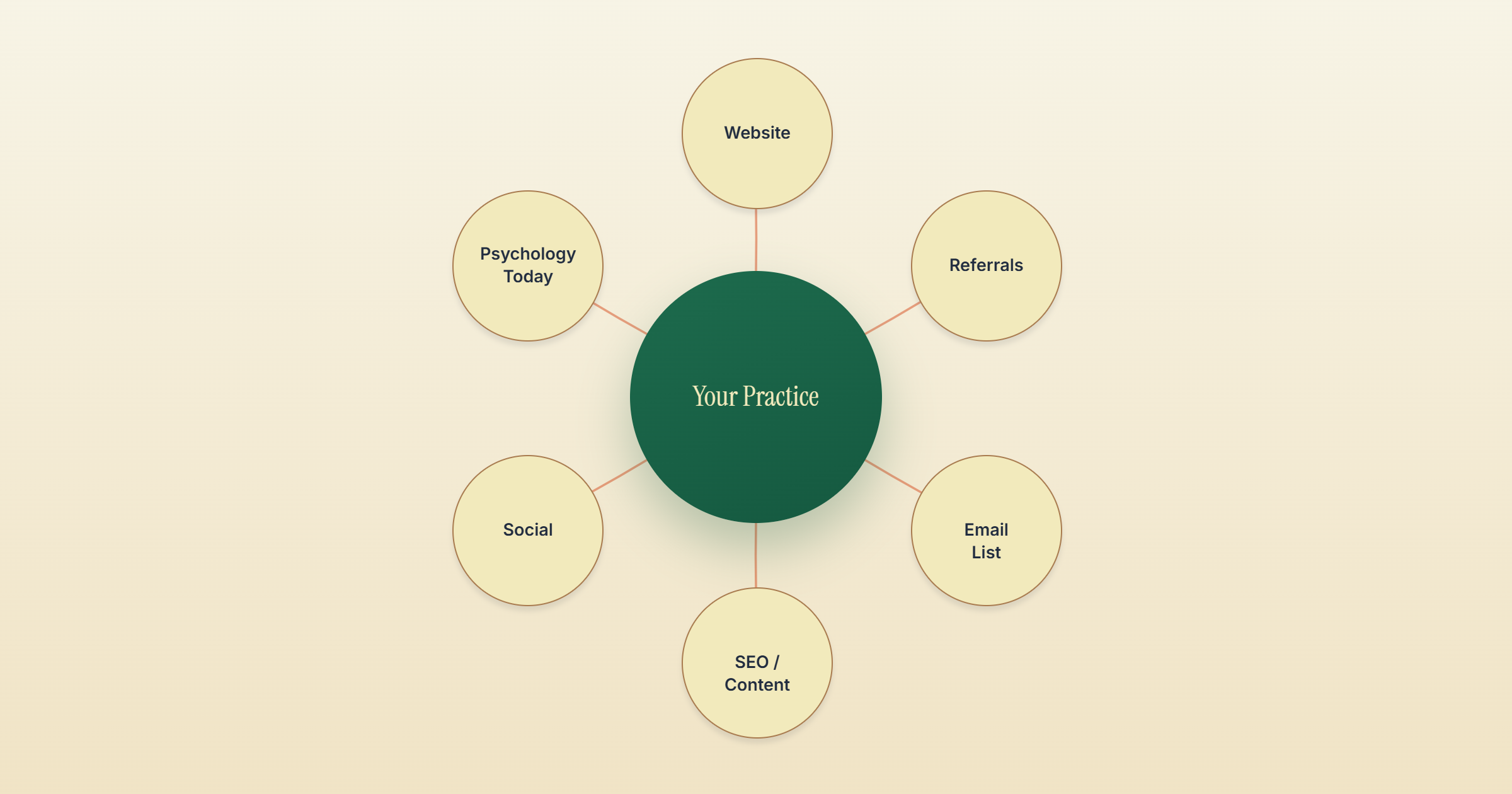
It doesn't mean abandoning Psychology Today. For a lot of practices, it's still a reasonable piece of the mix. But it should be one channel among several, not the whole strategy.
A real plan usually includes:
A website that's built to convert, not just exist. Not a digital business card. A site with clear messaging, a defined ideal client, and a path from "I found this page" to "I booked a consult."
Content that builds authority over time. Blog posts, service pages, and FAQs that answer the exact questions your ideal client is searching for, so Google starts sending you people who've already self-selected as a good fit.
Referral relationships that send people somewhere built for them. A physician, school counselor, or fellow clinician sending a referral should land on a page that speaks directly to that referral's situation, not a general homepage.
A way to capture and follow up with interest that isn't ready to book yet. Most people don't reach out to a therapist the first time they think about it. A marketing plan accounts for that gap instead of losing those people entirely.
Ownership. Whatever channels you use, the goal is to build something that's yours: your list, your content, your search rankings, your reputation, not just your spot in someone else's directory.
Where to Start
If you already have a Psychology Today profile, don't tear it down. Make it work harder while you build the rest — tighten the profile copy so it's not underperforming, so at minimum, the piece of your marketing you don't control yet is pulling its full weight.
But the bigger opportunity is what happens next: a website and content strategy that's actually yours, built around your specific niche, your specific voice, and the specific clients you want to work with. Not a rented listing you're hoping the algorithm favors this month.
Psychology Today can be part of your marketing. It was never meant to be all of it.