There's a particular kind of discomfort that many therapists describe when they start thinking about marketing their practice.
It's not that they don't want more clients. It's not that they don't believe in the work they do. It's that the marketing advice they encounter — the urgency tactics, the fear-based copy, the manufactured scarcity — feels completely at odds with who they are and what they stand for.
They've tried it. Posted the countdown timers. Written the "are you struggling with anxiety?" hooks. Pushed out the content that's supposed to create pain points and drive clicks.
And then felt vaguely unsettled by the whole thing.
If that sounds familiar you're not alone. And more importantly you're not wrong to feel that way.
Why traditional marketing tactics feel wrong for therapists
Traditional marketing borrows heavily from sales psychology. Create urgency. Amplify pain. Position yourself as the only solution. These tactics work in certain contexts — but they work by manufacturing emotional states in the reader. Anxiety, fear of missing out, a sense of inadequacy.
For a therapist that's a profound conflict.
Your entire professional practice is built around helping people regulate the very emotions that manipulative marketing is designed to trigger. You spend your working hours helping clients move away from anxiety and toward clarity, safety, and self-understanding. Then you close your laptop and write copy designed to do the opposite.
No wonder it feels icky.
The good news is that values-aligned marketing not only feels better — it actually works better in the therapy space. Here's why.
Your clients are different
The people seeking therapy are often already dealing with anxiety, overwhelm, and emotional dysregulation. They are particularly sensitive to manipulative tactics — and particularly good at detecting them.
A potential therapy client who lands on your website and senses manufactured urgency or fear-based messaging doesn't convert. They leave. They feel unsafe. And they go looking for a therapist whose online presence feels more like the experience they're hoping to have in the room.
The therapists who attract the most aligned clients consistently are the ones whose marketing feels calm, clear, and honest. Not because they're following a formula — but because their online presence genuinely reflects how they actually work.
What values-aligned marketing actually looks like
It doesn't mean being invisible. It doesn't mean never talking about what you offer. It means building your marketing around the same principles you bring to your clinical work.
Clarity over manipulation
Instead of amplifying pain points to drive action, describe clearly and honestly who you work with and what working with you looks like. A potential client who understands exactly what you offer and feels it resonates with them is a far better fit than one who clicked because they felt afraid.
Specificity over vague promises
"Transform your life" is a marketing phrase. "I work with women navigating the transition out of high-pressure careers who are trying to figure out what they actually want" is a description. One creates a vague emotional pull. The other creates genuine recognition in the right reader.
Trust built over time rather than urgency manufactured in a moment
Your website, your social presence, your content — these are all opportunities to demonstrate your approach, your values, and your way of thinking before a potential client ever reaches out. That accumulated trust is more durable than any urgency tactic. And it tends to attract clients who are genuinely ready for the work.
Honesty about the process
Therapy is not a quick fix and pretending otherwise attracts clients who aren't ready for what it actually requires. Being honest about what the process involves, what commitment it takes, and what outcomes are realistic is both ethically correct and practically effective. The clients who self-select based on honest information tend to be the most engaged and the most likely to do meaningful work.
The role your website plays in all of this
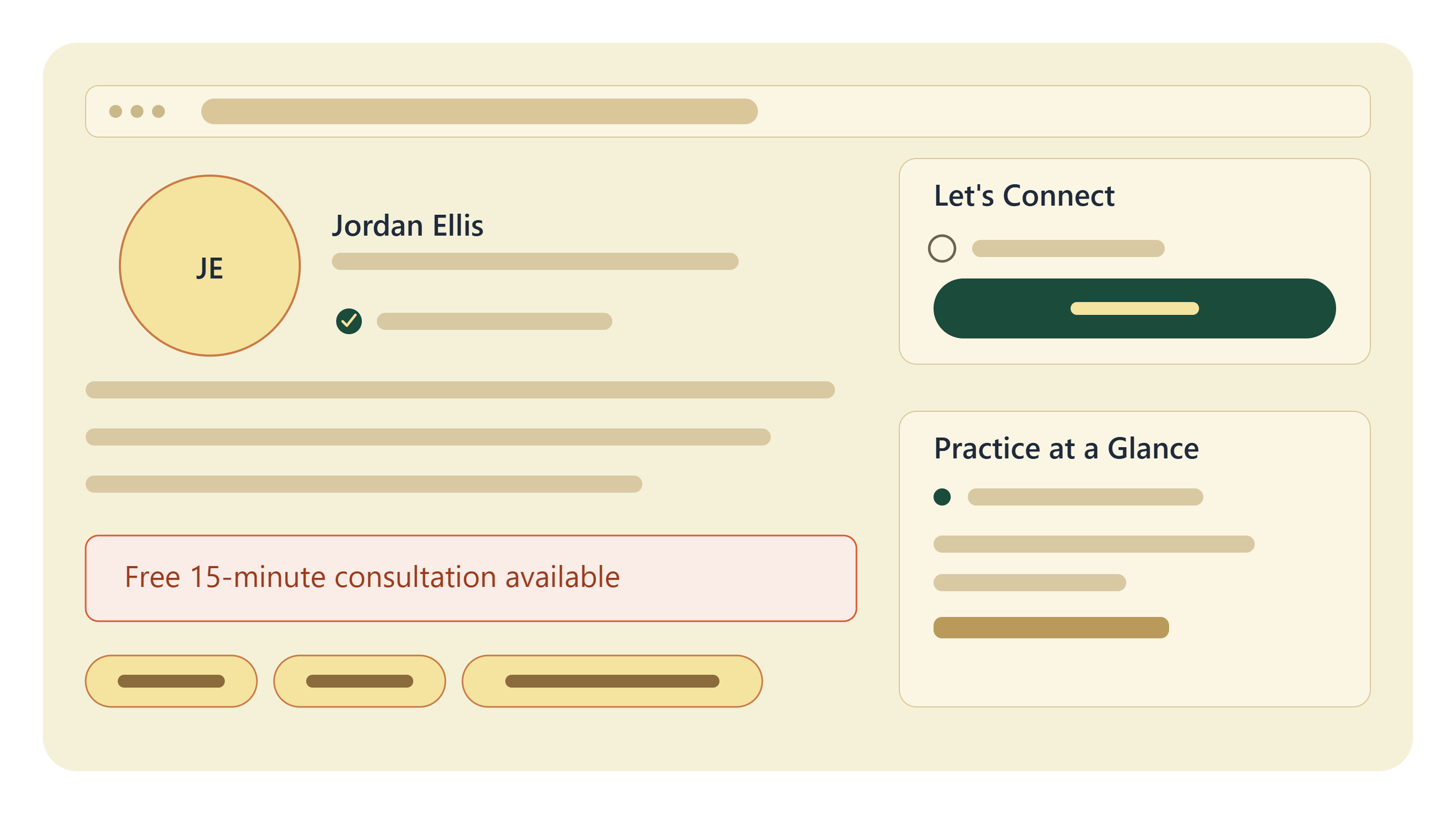
Your website is often the first extended encounter a potential client has with your practice. It sets the tone for everything that follows.
A website built around values-aligned marketing principles feels noticeably different from one built around conversion tactics. The language is warmer. The calls to action are invitations rather than demands. The photography shows a real person rather than an aspirational stock image. The about page reads like a genuine introduction rather than a credentials list.
That difference is felt before it is consciously understood. A potential client in a vulnerable moment doesn't analyse your website — they feel it. And the feeling your website creates is the first impression of what working with you might be like.
That's a significant responsibility. And an equally significant opportunity.
Calmly said
The therapists I work with who have the most sustainable practices are not the ones with the most aggressive marketing. They're the ones who have figured out how to be genuinely visible in a way that feels true to who they are.
Their websites feel like them. Their social content sounds like them. Their marketing doesn't create anxiety — it resolves it, by giving a potential client exactly enough information to know whether this practice is the right fit.
That's not a compromise between effective marketing and ethical practice. That's what effective marketing looks like in the therapy space.
You don't have to choose between growing your practice and staying true to your values. The most sustainable path forward is the one where those two things are the same.
A note on getting started
If you've been putting off building or updating your online presence because the whole thing feels misaligned with who you are — that hesitation is worth paying attention to.
The solution isn't to push through the discomfort and do marketing that feels wrong. The solution is to build a presence that actually reflects your practice, your values, and the experience you create for your clients.
That's what I help therapists do.
If you're ready to talk about what that could look like for your practice, book a free 30-minute call here.