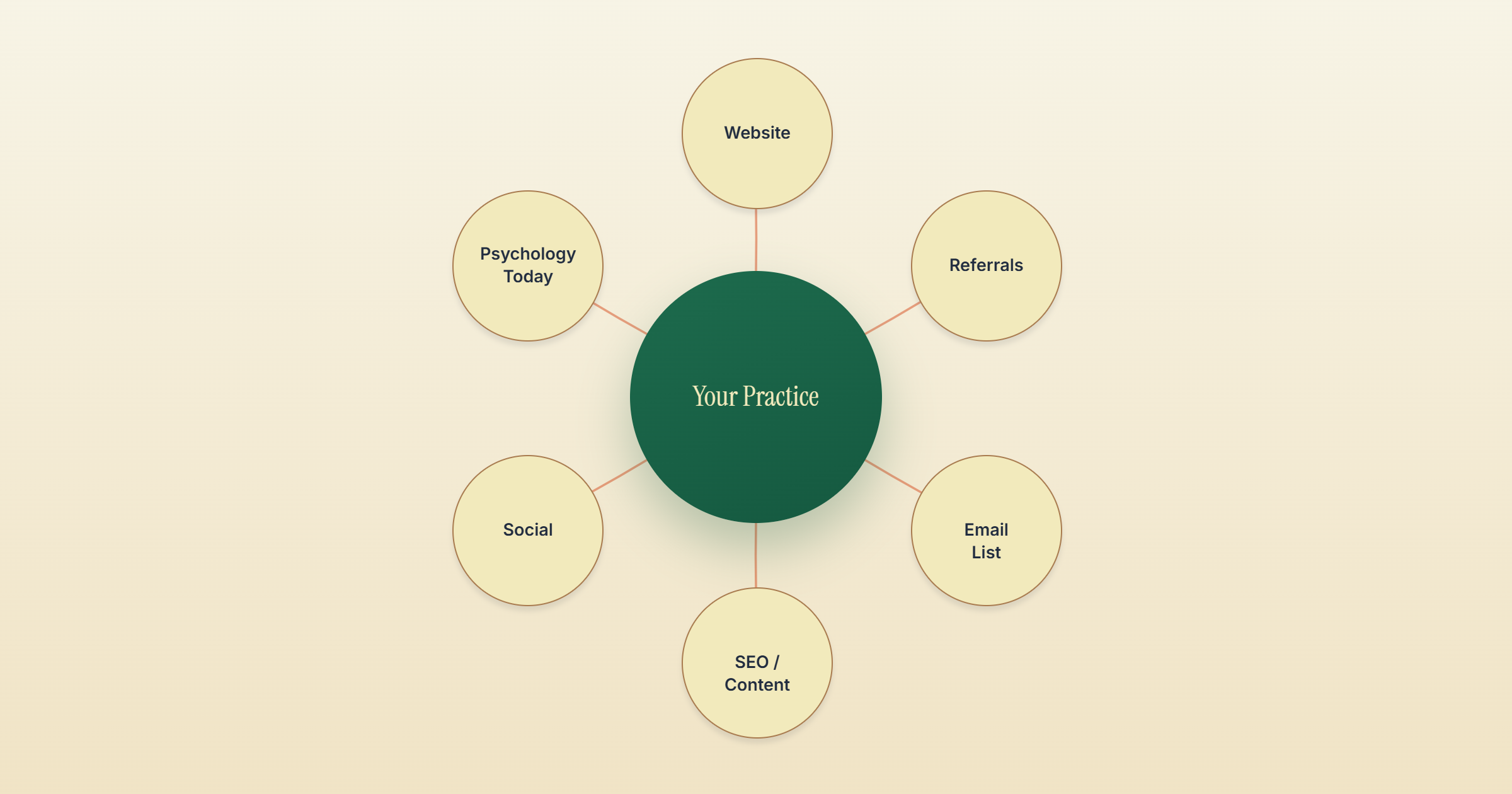
You didn't go into this field to become a marketer. Nobody trains a therapist, psychotherapist, or Registered Social Worker on client acquisition, and for a long time, that gap didn't matter much. A decent listing on Psychology Today and a few referrals were often enough.
That's changed. Not because the work changed, but because how people search for help has changed. Here's a real look at what actually works now, and what's quietly stopped working as well as it used to.
Your Website Is Your Hub, Not Your Brochure
A lot of practices still treat their website as a digital business card, a site that exists to show a headshot, an address, and a few bullet points about the practice. In 2026, it needs to do more than that: answer real questions, make booking obvious, and keep working for you between sessions instead of sitting still.
We've written a fuller breakdown of this specific shift if you want the deeper case: How Canadian Therapists Can Use Their Website as a Growth Lever.
Clients Are Starting to Ask AI to Find Their Therapist, Not Just Google
Someone looking for help doesn't always open Google and click through a list of websites anymore. Increasingly, they ask a chat tool like ChatGPT or Claude a direct question, "find a trauma therapist in Toronto," "what's the difference between a psychotherapist and a psychologist," and expect a real answer back, sometimes with a name attached. If your website has never been built with AI search capability in mind, you're simply invisible in that conversation, even if you'd rank perfectly well in a traditional Google search.
The fix isn't complicated, even if it sounds technical. These AI tools work by reading your website and pulling out clear, direct answers to real questions. A page full of vague, polished marketing language doesn't give them much to work with. A clear, honestly written FAQ, "How much does therapy cost," "What happens in a first session," does. The plainer and more specific your answers are, the easier it is for an AI tool to find them and repeat them to someone asking.
This is a new layer to think about, not a replacement for showing up well in regular Google search. Both matter, and thankfully, the kind of content that helps with one tends to help with the other too.
Directories Still Matter, They're Just Not the Whole Plan
Psychology Today, and niche directories built for specific communities, are still a real source of inquiries. But a directory listing puts you in a category you don't control, the layout, the competition next to your profile, and what happens after someone clicks away are all outside your hands.
Use directories, but don't let them be your only source of new clients. Anything that only exists on someone else's platform can change, get more expensive, or get more crowded without warning.
Your Google Business Profile Matters More Than Most Social Platforms
If you don't have a Google Business Profile, or you have one that's gone stale, you're missing the single most common way local clients actually find a practice: searching "therapist near me" and seeing who shows up. No profile, or a neglected one with old hours and no reviews, and you've likely already lost that person before they ever reach your website.
For local, in-person or hybrid practices, a properly filled-out Google Business Profile often does more work than any single social media account. It's often the first real impression a prospective client gets, before your website, before anything else.
Keep it current: accurate hours, a clear description of who you work with, and real photos rather than a blank default. It's a small amount of setup for something that keeps generating visibility with almost no ongoing effort.
Create Blog Posts That Answer Real Questions
A blog with three posts from two years ago doesn't help anyone. A handful of genuinely useful pieces, written in plain language, answering the specific questions your prospective clients already have, does. Things like: what does a first session actually look like, how does virtual therapy work, what's the difference between the designations you hold and a related one.
This is also exactly the kind of content that supports the AI-visibility point above. Clear, honest, specific answers serve both a human reader deciding whether to reach out, and a system trying to understand what your practice is actually about.
Referral Partnerships Beyond Other Clinicians
Most practices already think about referrals from other therapists or physicians. Fewer think about adjacent professionals who serve the same audience without being direct colleagues, brand photographers who specialize in therapist headshots, other wellness practitioners, even web designers who work specifically in this space. A small, genuine network of people who understand your work and who you'd actually recommend can bring in a steady, low-effort stream of well-matched referrals.
Reduce Friction With the Tools You Already Use
If you use Jane App, or a similar practice management platform, for booking and records, your website should work with it, not around it. A visitor who has to leave your site, find a separate booking link, and figure out an unfamiliar interface is a visitor who sometimes just doesn't follow through. The fewer steps between "interested" and "booked," the better, and this is one of the more overlooked, purely practical improvements available.
Community Visibility Still Works, in Person and Online
A practice that operates in isolation misses something a website alone can't replace: other people who know your work well enough to actually recommend you. Referrals rarely come out of nowhere, they come from someone having met you, heard you speak, or seen your name come up more than once.
Professional associations, local meetups, and online communities specific to your discipline aren't just for continuing education credits. They're where those relationships actually start. This kind of visibility compounds slowly, it's not a quick win, but it's also not something a competitor can copy or replicate quickly, which makes it one of the more durable things you can build.
Trust Signals That Matter Today
A few things build trust faster than they used to, and neglecting them costs more than it once did:
- Privacy handling. Clients notice how a site handles their information, especially for anything resembling an intake form. A visible, genuine privacy policy and a properly secured contact form aren't just a compliance checkbox, they're a quiet trust signal.
- Real reviews, gathered honestly. A handful of genuine Google reviews, gathered through normal, non-pressured means, does more for trust than a stock-photo testimonial ever will.
- A site that looks current. An outdated-looking website doesn't just look dated, it can quietly suggest a practice that isn't very active, even when that's not true at all.
The Takeaway
None of this requires becoming a marketer. It requires a website and a few supporting pieces that are actually built for how people search and decide today, not how they did five years ago. That's a different problem than "get better at marketing," and it's one that's solvable without it becoming your job.
You support your clients. Making sure the right ones can actually find you is what we're here for. Book a free discovery call and let's talk about what would actually make a difference for your practice.