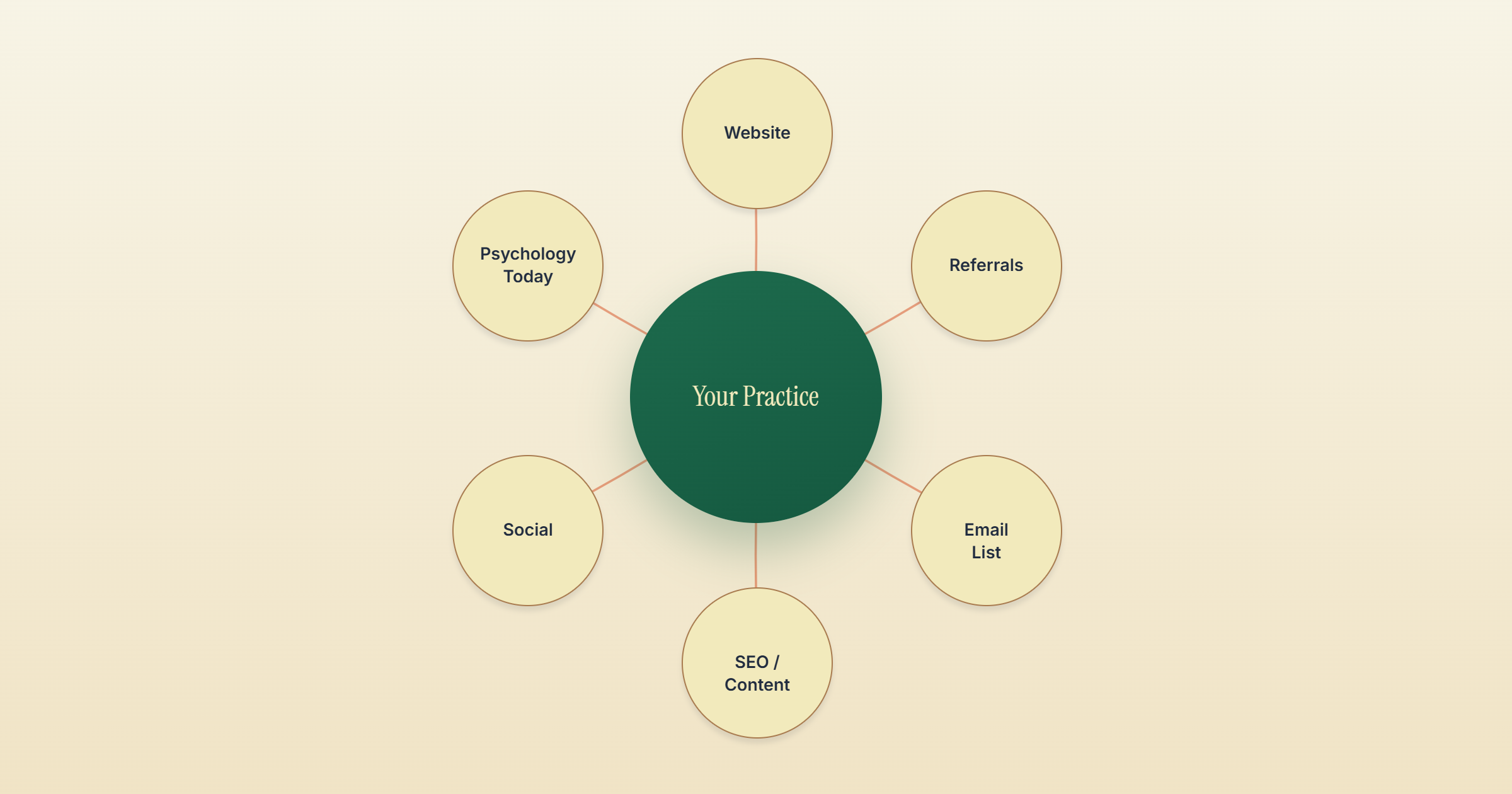
If you're a therapist in private practice, Psychology Today was probably one of your first moves.
It makes sense. You create a profile, add your photo, write a bio, and suddenly you're listed in one of the most visited mental health directories in North America. New clients can find you. You start getting inquiries. It works.
For a while.
But at some point — usually a year or two into private practice — a question starts forming. You're paying the monthly fee, the inquiries are okay but not great, and you're looking at your colleagues with their beautiful custom websites and wondering if you're leaving something on the table.
I've had that conversation with a lot of therapists. Here's my honest take.
What Psychology Today actually does well
I want to be fair about this because Psychology Today has real value, especially at the beginning.
The directory has enormous domain authority. When someone in your city searches "therapist near me" or "anxiety therapist Toronto," Psychology Today pages often rank on the first page of Google. You're essentially borrowing their SEO credibility without having to build your own.
It's also fast. You can be findable online within hours of creating a profile. For a therapist just starting out who needs clients now, that matters.
And the intent is there. People using Psychology Today are actively looking for a therapist. They're not browsing passively — they're searching with purpose.
So why does it feel limiting after a while?
The problem with Psychology Today as your primary presence
Here's what I've noticed working with therapists on their websites over the past five years.
Psychology Today gives you visibility. It does not give you differentiation.
When a potential client opens the directory and sees your profile alongside twelve other therapists in your city, all with similar credentials, similar headshots, and similar 150-word bios — you become interchangeable. The client is essentially comparison shopping, and the decision often comes down to who has availability and whose face they felt most drawn to in a two-inch thumbnail.
That's a difficult position to be in when you've spent years developing a specific approach, a specific niche, and a specific way of working with clients.
Your profile also lives on Psychology Today's terms, not yours. You can't control the design, the layout, the surrounding content, or how your work is presented. You share a page with competing therapists. The branding is theirs, not yours.
And perhaps most importantly — a Psychology Today profile doesn't build anything. You pay the monthly fee, you get the visibility that month. Stop paying and you disappear. There's no compounding value, no SEO authority building in your name, no brand presence accumulating over time.
What a well-built website does differently
When I built Monica Dosanjh's website, she was coming directly from Psychology Today as her primary source of referrals. She had the clients and the expertise — but nothing online that was truly hers.
After her site launched, colleagues who saw it reached out specifically to tell her it reflected exactly who she was. That's not something a Psychology Today profile can do. A directory listing tells a client what you do. A well-built website tells them who you are.
That distinction matters enormously in therapy.
A potential client in a vulnerable moment isn't just looking for a therapist. They're looking for their therapist. The one who gets their specific situation. Whose words and tone and visual presence make them feel understood before they've ever reached out.
A custom website built around your voice, your approach, and your ideal client does that work before you ever speak. A directory profile cannot.
The SEO comparison — and why it's closer than you think
Here's where therapists often assume Psychology Today wins automatically. And in the short term, they're right. The directory's domain authority is genuinely hard to compete with for generic searches.
But for the searches that actually matter most to your practice — searches with your specific modality, your specific community, your specific location — a well-optimised custom website can absolutely compete. And unlike a directory listing, it gets stronger over time.
Every blog post you publish, every page you update, every case study you add builds your site's credibility with Google. A Psychology Today profile doesn't do that. It stays static while your website compounds.
I've seen therapists in moderately competitive markets rank on the first page of Google for "therapist in [their city]" within six to twelve months of launching a properly optimised Webflow site. That organic ranking belongs to them permanently — not to a directory they're renting space in.
The quality of client question
This is the part that doesn't get talked about enough.
A therapist I worked with made an observation after her website launched that has stuck with me. The clients who found her through her own site were different from the clients who found her through the directory. Not better or worse as people — but more aligned. They had read her approach, understood her values, and had made a considered decision that she was the right fit before reaching out.
The clients from the directory sometimes arrived with less certainty. They had seen a photo and a short bio and decided to try. The fit wasn't always there.
When your website clearly communicates who you are and who you work best with, it pre-qualifies clients before they ever contact you. You spend less time on consultations that don't convert. You work with more people who are genuinely aligned with your approach.
That's not a small thing. That's the difference between a practice that drains you and one that sustains you.
So which one should you use?
Honestly — both, especially early on.
Psychology Today is a reasonable source of visibility while your own website is being built and gaining traction. The mistake isn't using Psychology Today. The mistake is staying dependent on it.
The goal is to reach a point where your own website is doing the heavy lifting — bringing in the right clients, reflecting your practice accurately, building your reputation over time — and Psychology Today becomes a secondary channel rather than your primary one.
That transition doesn't happen overnight. It takes a few months for a new website to gain SEO traction. But once it does, the results compound in a way that a directory listing never will.
A practical next step
If you're currently relying primarily on Psychology Today and you're ready to build something that's truly yours, start by asking yourself one honest question:
If a potential client visited your website right now, would it reflect the quality and depth of the work you actually do?
If the answer is no — or if you don't have a website at all — that's the gap worth closing.
Book a free 30-minute call here and we'll look at your current situation honestly and talk about what would actually make a difference for your practice.

 Certified Webflow Partner